The Issue with Mummy Movies: Brief Musings of Lee Cronin’s The Mummy
Lee Cronin brings a new take to The Mummy franchise to middling effects.

In the pantheon of classic movie monsters, stacked up against legends like Dracula and Frankenstein, the Mummy struggles the most when being brought back to life. Whereas the other movie monsters have gone through multiple reinventions through various genres. Like recently, The Bride! is Frankenstein and The Bride of Frankenstein as Bonnie and Clyde.
In part, I believe the iconography of The Mummy is what makes writers hold back from fully utilizing their arsenal. What people remember are bandages and Egypt, and when an idea is locked in a location because of association writers tend to dismiss the potential as very limiting.
How many mummy movies can we really do with Egypt? The Mummy: Tomb of the Dragon Emperor brought Chinese mummies to the screen and ended with a tease to get away from Egypt yet again by mentioning Peruvian mummies but, inevitably, the story does come back to Egypt.
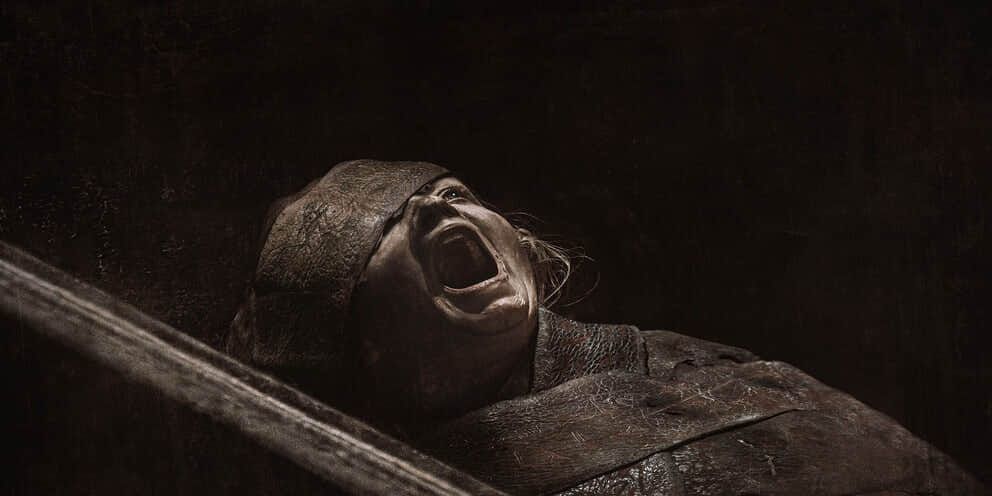
Lee Cronin’s The Mummy is a solid pitch for a reimagined modern take on this century old creature feature. Having a little girl be the titular mummy is a haunting visual that goes against the classic silhouette and is rich with character potential for a family drama. Sadly, that potential went nowhere.
The movie starts off with a prologue involving an Egyptian family keeping a sinister looking sarcophagus from being opened before introducing the main western family.
Dad is a news reporter looking to make it big back in the United States, they’re in Egypt temporarily, but while he was distracted by a phone call regarding his job the mother of the Egyptian family from the prologue steals his daughter.
The film then jump cuts eight years later when a plane crashes and authorities find the sinister sarcophagus with the missing daughter still alive, wrapped in bandages.
At this point I think we should ask, what makes a mummy movie?
Visually it’s Egypt, desert, pyramids, sarcophagi, undead, curses, vengeance, etc.
What about narratively?
We can start with the obvious: colonialism.
Before being a horror story a mummy movie is adventurous. Foreigners going to another land digging up culture and profiting off treasures they find. The experience can be seen as exotic on the big screen while also letting the horror be a commentary on their actions.
Lee Cronin’s The Mummy isn’t about colonialism. If anything it felt like Egyptians were the bad guys, even though we did have a ‘good cop' character. The movie sets up the Egyptian family, specifically the mother whom doesn’t have a name and is only credited as The Magician, as the big bad.
The western family also doesn’t want to stay in Egypt. They’re not looking for ancient treasure, and the father as a news reporter isn’t even profiting off their culture by selling stories, which could have been a valid modern interpretation.
Now let’s get back to the question: What makes a Mummy movie?
Or, better yet, what makes a Mummy different from other undead monsters?
A few years ago I asked myself what the difference is between a mummy and a zombie. They’re both undead and function as advancing monsters in pursuit, but zombies have been much more popular. They too started as commentary on a culture, but they’ve not only thrived but blossomed in other genres; zombie romance, Comedy, superhero, etc. while the Mummy has been stuck in the sand.
The difference, I found, is in character. A zombie is a zombie whether you knew who the person was or not before they died. A Mummy takes being an undead to the next step with their motivation being to come back to life. They need to be fleshed out like any other character on screen in order for their presence to be felt.
The Brendan Fraser interpretation of The Mummy had been more adventurous and romantic, but the mummy’s motivation was to cheat death to be with the one he loved. When his love eventually turns her back on him in The Mummy Returns the titular villain finally accepts his fate in death and is a mummy no more.
What makes a Mummy movie is the motivation, the human behind the monster, for their return to the living. A Mummy isn’t just an undead monster, but one that fights for life.
With that in mind, Lee Cronin’s The Mummy could go two ways; either the daughter’s motivation is to escape death and reunited with her family or destroy them out of rage and vengeance for letting her go.
Instead, what happens is a sequence of modern horror tropes that don't fully align with the mummy mythos. Many have called it a reskinned Evil Dead film, and those arguments wouldn't be far off, but I felt the choices they made to make it a modern horror movie took away what could have been a thrilling mummy movie.
In the film's defense, there is a subplot of the father and his daughter bonding over Morse code, which comes back later in the film as a way for the daughter to communicate with her father in her mummy state, which makes you think the story is going to be the daughter/family against the curse, but no. Her blip of agency was quickly ignored in favor of jump scares and creepy girls doing demon things.
It's quite disappointing how much of this story isn't about the daughter, the titular mummy. She clearly loves her family so it's not a revenge plot, but her agency in monster form has been dulled to the point where the ending isn't satisfying even though the beats on paper should work.
But above all else, what makes this not a mummy movie is... she's not a mummy. The movie confirms in dialogue multiple times how she's possessed by a demon. The ceremony to mummify her requires her to be alive so that the demon can be trapped inside her until she ages and dies, I guess. The ceremony wasn't fully clear on the sealing method, but the gist is you need to swap out live humans to keep it contained. So, on principle, this 'mummy' doesn't die nor has any battle against death. She's alive. She doesn't want vengeance. It's not about colonialism. This isn't a mummy movie.
There were certainly interesting ideas. As horror, there are some squirm worthy scenes that went farther than I expected. Looking at you toe nail scene. As a family story I thought it set up some interesting threads that could have been meaty if explored, like the father/daughter relationship.
 Cody Enos
Although for every good stitch on this movie there were a couple following that was baffling. Like when the daughter is brought home after being discovered, there's this elongated scene of her parents pulling her up the staircase, and it was so long and so loud that it almost felt comedic. And then later in the film the daughter is spider crawling across the house in the most agile way, but I'm simply sitting there asking myself, 'why is a mummy spider crawling across the ceiling?'
So, what makes a mummy movie? Nothing in this one. I'm all for reinvention to keep classics alive, but when your movie is actively not adhering to the principles you start to question why you're there.